Blockchain research · Analysis
Base Denim: what actually changed for wallet and payment integrations
Base replaced Flashblocks with native 200 ms blocks in November 2026. Here is what changed for transaction observers and payment state machines.
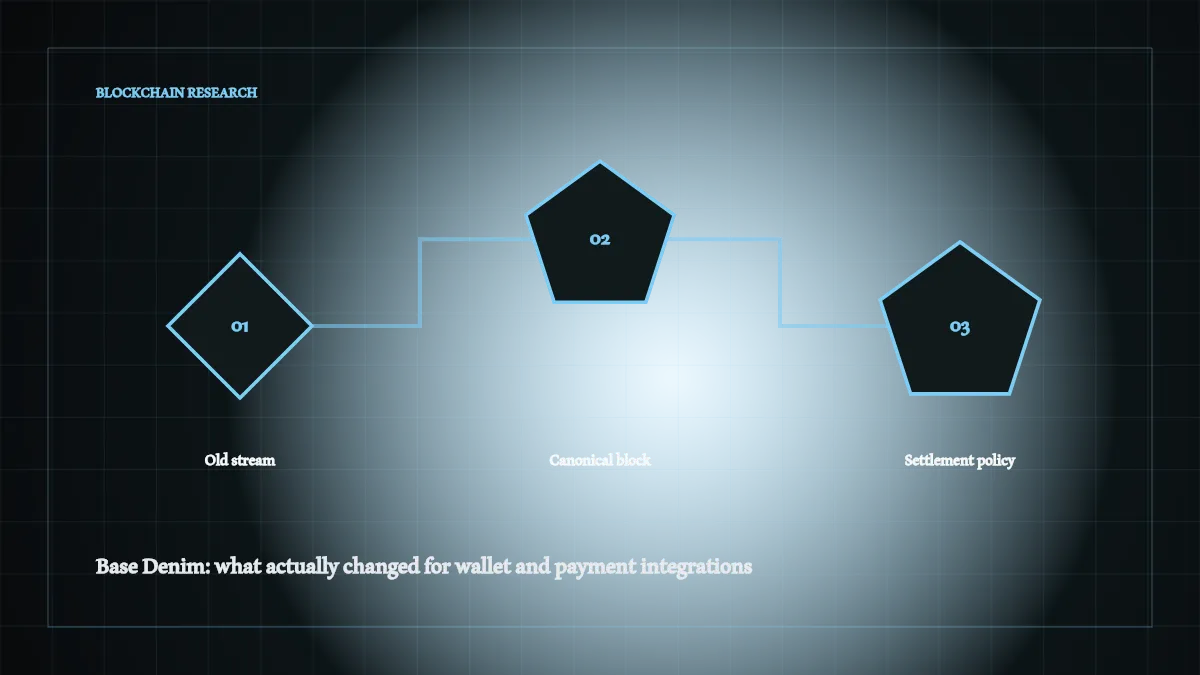
Base’s migration guide dates Denim’s Mainnet activation to November 5, 2026. After activation, a native 200 ms block became the unit of inclusion. Applications that fed a status badge from the old Flashblocks stream needed a different data source and a careful review of what the badge meant.
Translate the subscription and receipt checks
Base directs integrators toward canonical new-head and log subscriptions. Poll the regular transaction receipt when needed. The pending tag may still be accepted, but according to the guide it refers to the latest canonical block and no longer exposes Flashblocks preconfirmation state.
Source · Base Denim migration guide · Ethereum.org JSON-RPC methods and receipt format
Separate fast inclusion from operational settlement
A payment product can acknowledge the first canonical receipt promptly and hold account credit to a policy for the asset and destination. Name these states separately so operators can tell whether the wait is in the chain observer or in the application’s credit flow.
Source · Base Denim migration guide
Review time windows measured in blocks
Base calls out a compatibility detail: historical facilities that retain a fixed number of block entries now cover less elapsed time. Review block-number cutoffs in polling, proof or bridge processes, and keep time-based requirements explicit.
Source · Base Denim migration guide
What to take away
For a migration test, exercise receipt latency, missed subscriptions and duplicate processing, then confirm the UI distinguishes inclusion from any later account-credit policy.