Product management · Analysis
The small number that breaks a payment total
Design amount handling around units, rounding rules and the exact value you can later reconcile across ledgers.
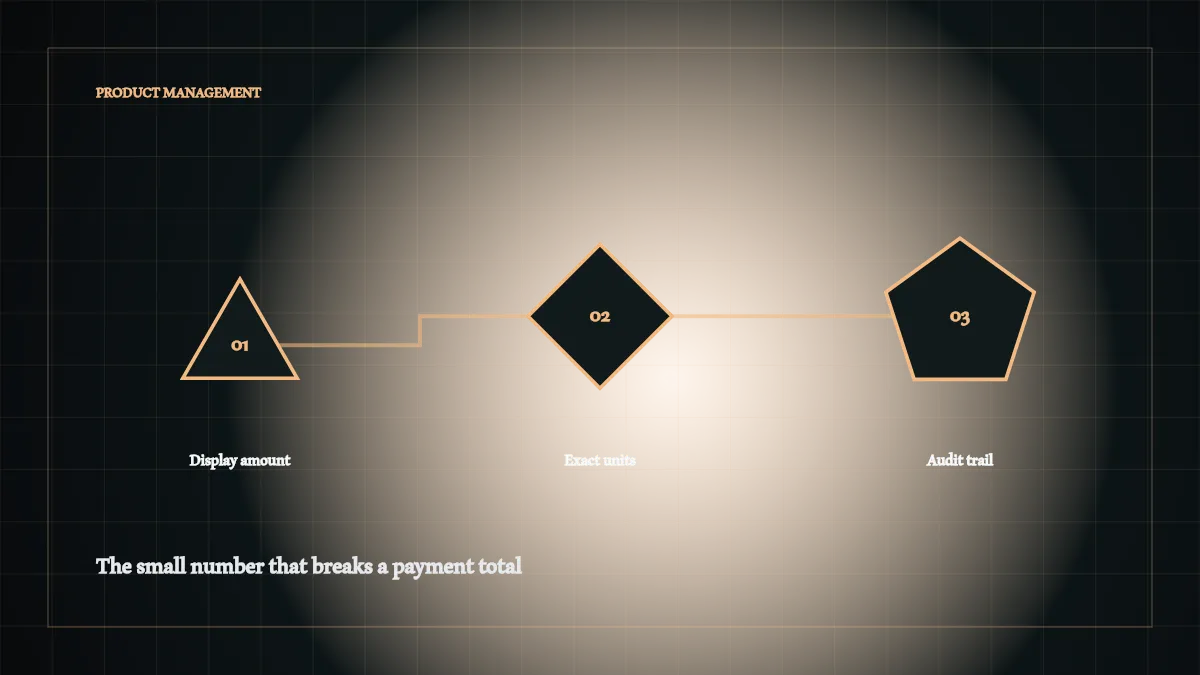
An amount that looks like 1.25 at checkout may be represented as 125 by one processor and 1,250,000 by a USDC integration. The display is compatible. The underlying integers carry different units.
Type the payment amount
Carry currency or token identity, network where relevant and integer denomination together. Stripe documents minor-unit expectations and currency-specific exceptions in its supported-currencies reference. Circle’s transfer example also converts a USDC string to six-decimal subunits without floating-point arithmetic.
Source · Stripe · Supported currencies · Circle · USDC unit examples
Choose where rounding happens
Agree on the rule for fee, tax, discount and split totals. Apply it at a documented stage rather than letting a browser or spreadsheet decide independently. A useful fixture combines one awkward fractional discount with multiple line items and a partial refund.
Compare raw and rendered amounts
Store the exact input to the external system and show the formatted amount in the internal timeline. That gives finance a way to compare the order total with the provider record, including zero-decimal and currency-specific payout cases.
Source · Stripe · Supported currencies
What to take away
Treat a naked integer in support logs as an incomplete amount. The record should say how to read it without reconstructing surrounding application code.