Product management · Analysis
How to verify prompt-cache savings in production
Measure warm and cold traffic separately and track real cached usage before making product decisions based on prompt caching.
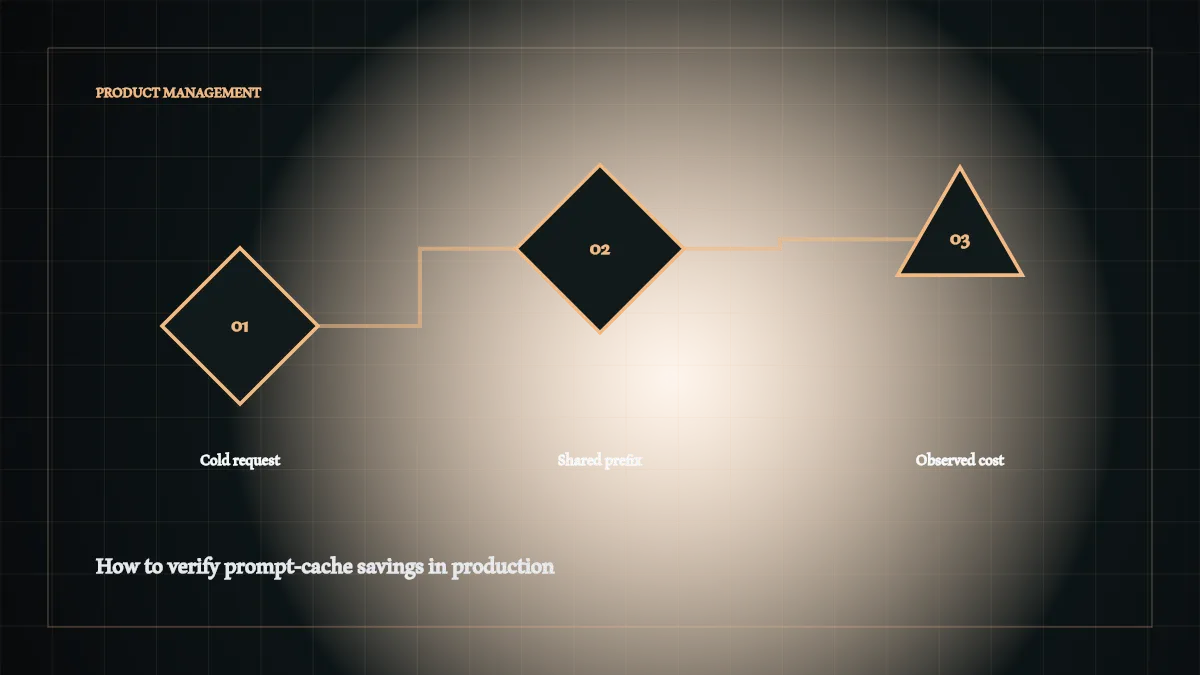
A document assistant feels fast during a demo built around one policy manual. Its production queue contains unrelated workspaces and policy releases. The useful question is how much of that production traffic actually reuses a prefix.
Keep the shared instructions stable
OpenAI’s prompt caching relies on exact prefix matches. Put stable instructions first and per-request content after them where that preserves meaning. When policy text changes, update it deliberately and retain the version in the request record. Reuse should follow current policy.
Source · OpenAI · Prompt caching
Read the provider usage field
Look at cached input tokens and total input tokens by workflow. Keep first requests and repeated requests visible in separate groups, and measure response time at a percentile useful for that service. A single test session can overrepresent traffic that reuses the same prefix.
Source · OpenAI · Prompt caching
Include the rest of the workflow cost
The FinOps Foundation covers AI costs beyond inference alone. Compare changes in retrieval, rework and staff review alongside model usage, especially if instructions were reorganized. A cheaper request can still produce a more expensive completed case.
Source · FinOps Foundation · Total Cost of AI
What to take away
Compare cold and warm requests on the same workload, including one policy revision. Check both answer quality and the actual provider usage recorded.