Automation & agents · Analysis
When a provider fallback changes the AI task
Decide which cases may switch models and test whether the new route still meets data, output and review requirements.
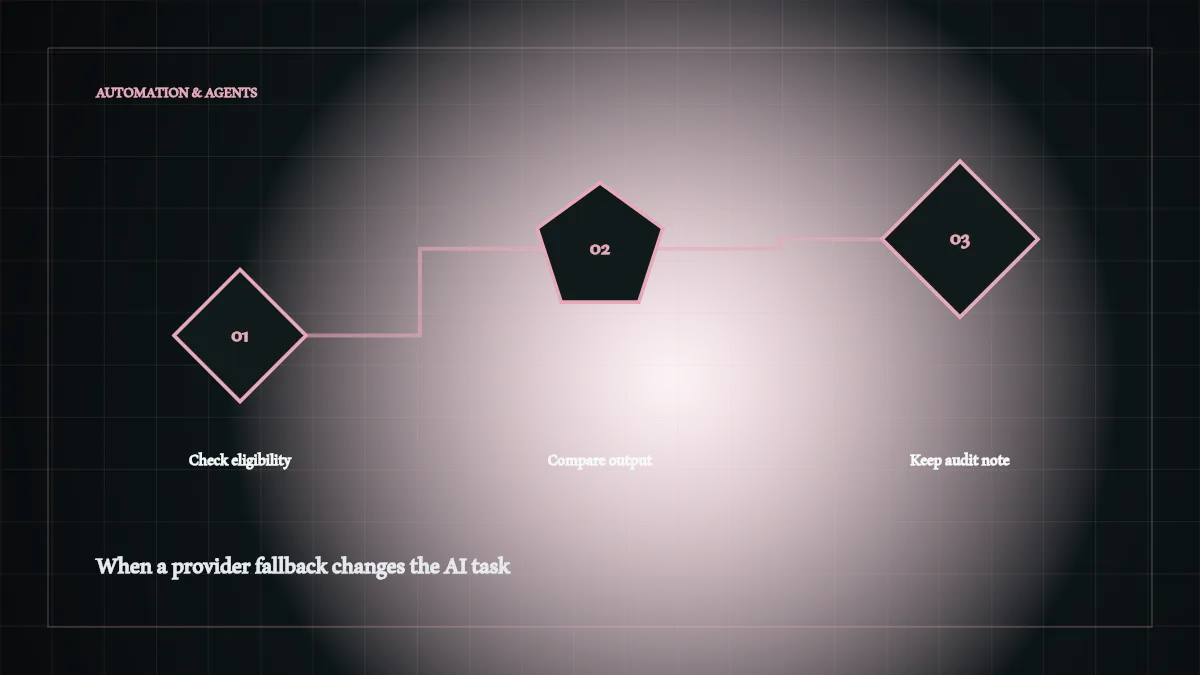
An OCR assistant loses access to a model during a document run. A substitute can read the image, but some customers only authorize processing at the original provider. Other customers need a field-level audit reference that the fallback does not return.
Eligibility comes before availability
Build a capability profile for each route: permitted data, region if relevant, supported media and required output references. Operational resilience has to fit the risk and governance requirements for the workflow.
Source · NIST · AI Risk Management Framework
Compare the outcomes people rely on
Use the same mock document with a handwritten line and a low-resolution scan. Grade whether the fallback gives a usable reference, whether uncertain output escalates and whether unsupported fields are clearly flagged.
Source · Anthropic · Agent evaluations
Show a deliberate degraded state
If replacement is disallowed or loses a required feature, move the job to a review or waiting state. Preserve the original request, decision and next step so the user knows what will happen.
What to take away
Fallback is acceptable only for the tasks and data you have evaluated for that route. An available model alone cannot establish equivalence.