Applied AI · Analysis
Where OCR-free document readers struggle with tables
Compare direct visual extraction and an OCR pipeline on invoice rows, wrapped labels, and page-spanning tables using a reference that preserves row relationships.
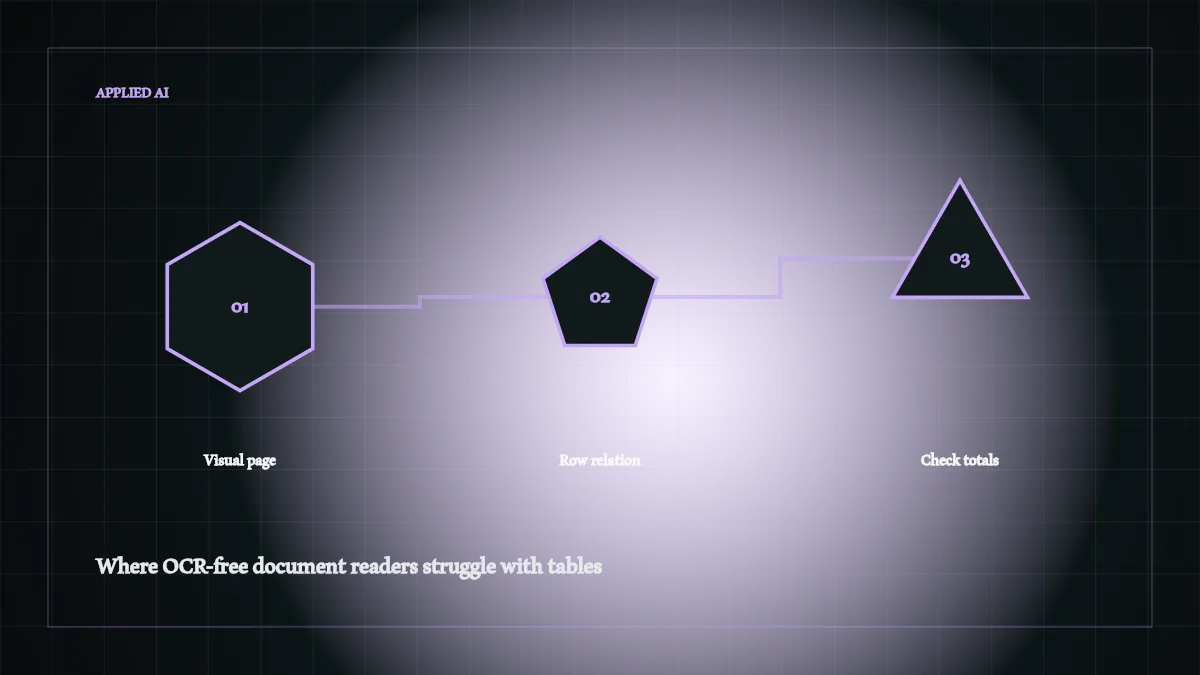
An invoice parser can capture every amount and attach each one to the wrong item. Testing a document reader therefore involves layout, particularly the assignment of text from neighboring columns and continued rows.
Choose a failure the output exposes
Donut presented a model that maps document images to structured sequences without a separate off-the-shelf OCR step. The design lets extraction use visual layout. Its gains on reported document benchmarks give a reason to run a comparison on local forms with their actual scan conditions.
Source · Kim et al. — OCR-free Document Understanding Transformer
Build a test around row identities
Use reference rows with the product identifier, quantity, unit rate, discount, and total. Include a line break inside a description, a subtotal immediately after a row, and repeated prices for two items. Score a row only if the values belong to the same item and preserve the order needed for reconciliation.
Use reconciliation to catch silent swaps
Check quantity times unit rate with defined rounding and known discounts. Compare line totals to the subtotal separately. If two swapped unit rates produce the same subtotal, the row score still catches the error. Give the review interface a crop of the source area so staff can resolve disputed associations.
What to take away
A comparison is useful when it shows which layout breaks each reader and provides a reference that a document reviewer can inspect.